

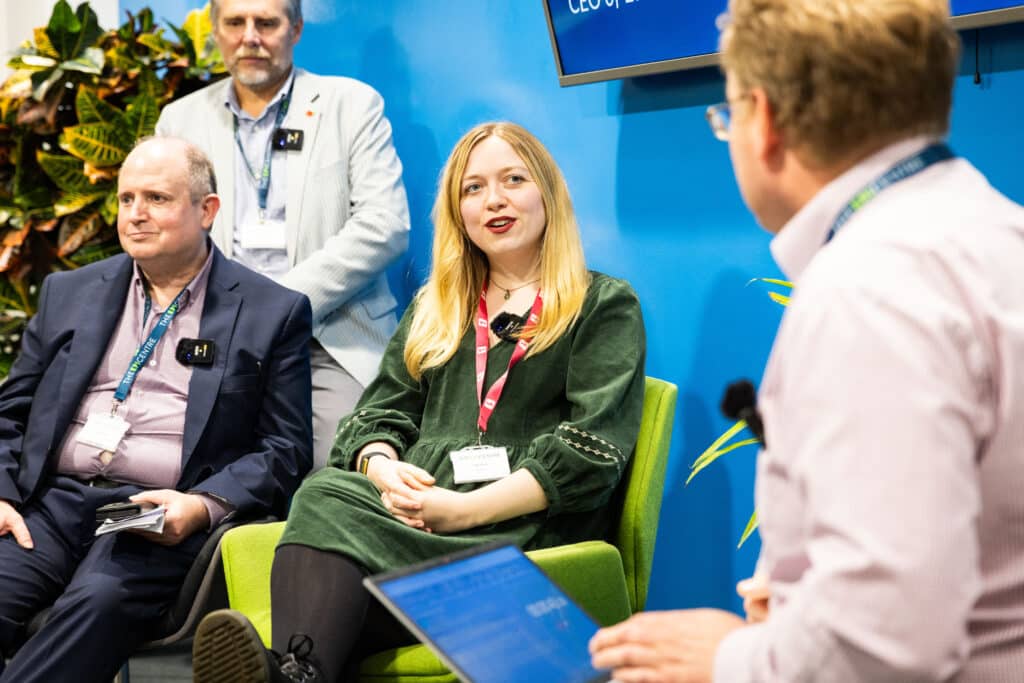
How The EpiCentre Startups are responsibly using AI as part of a small team.
In the third instalment of the EpiCentre podcast series, the conversation turned to artificial intelligence and what it really means for small and medium sized businesses. After funding and engineering, this discussion focused on AI as a working tool rather than a headline trend. For many SMEs, AI feels both unavoidable and overwhelming. The panel set out to cut through that tension and examine how businesses are actually using it today.
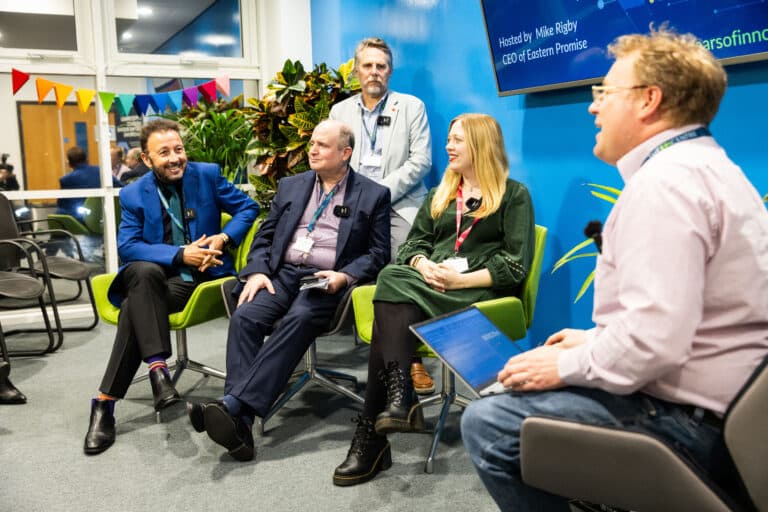
The discussion was hosted by Mike Rigby of Eastern Promise – The Podcast at The EpiCentre and brought together practitioners working with AI at ground level.
AI as Efficiency Not Magic
Justin Byrne of Certus Recruitment, a specialist recruiter in AI and SaaS roles, opened with a clear observation. AI is changing how businesses operate at speed. Tasks that once took weeks or months can now be completed in minutes. That acceleration is both exciting and unsettling. Every business is being affected, whether it intends to be or not.
For Jade Donno, Director of 1 Accounts Online, the value of AI is far more specific. In accounting, AI improves efficiency and reduces error. Background work can be automated which allows teams to spend more time supporting clients. Even simple uses, such as drafting emails from bullet points, create measurable time savings when repeated daily. The key is not removing human oversight but redirecting it.
Education and the Human in the Loop
Phil Spalding of Cambridge Online Learning Community brought an educator’s perspective. AI, he argued, is still in its early phase, similar to the early days of social media. There are many platforms and not all are appropriate or compliant for every user group. For businesses and educators alike, understanding what sits behind an AI tool matters as much as what it produces.
Spalding stressed the importance of human judgement. AI can hallucinate and produce confident but incorrect outputs. Knowing how to prompt effectively and how to question results is now a core skill. Without that, users risk accepting answers that are not suitable for purpose. AI does not replace thinking. It changes where thinking is applied.
Rethinking Work and Scale
Duncan Bird, Innovation Director at Oxford Innovation Space, based at University of Essex, explored how AI reshapes the nature of work itself. Generative AI makes tasks that were once complex fast and accessible. This changes how businesses think about staffing, time, and growth.
For early-stage companies, this shift is significant. Limited resources have always constrained ambition. AI reduces that constraint. Bird suggested it is only a matter of time before we see highly valuable businesses operating with minimal staff because AI handles much of the execution. This does not remove people from the equation. It changes what people focus on.
Data Control and Practical Adoption
A recurring concern was data ownership and control. Bird highlighted the growing use of small language models that operate entirely on a company’s own data without accessing the wider internet. These approaches allow businesses to use AI while retaining control of sensitive information and intellectual property. For many SMEs, this is a practical middle ground between capability and caution.
Justin Byrne returned to the barriers SMEs face. The market is crowded with tools claiming to be AI when they are not. Businesses can waste time selecting tools rather than improving operations. In recruitment, he also noted a shift in skills among younger workers who are highly adept at finding information but less experienced in decision-making without prompts. AI changes capability but also expectations.
Starting Small and Staying Focused
Jade Donno offered a practical warning drawn from her experience working with SMEs.
Many businesses think too big when approaching AI. There is a strong temptation to automate everything at once and to expect rapid transformation. In practice, this often leads to confusion, wasted effort, and stalled progress. Breaking adoption into small steps produces better outcomes. AI is most effective when applied to one clear problem at a time, where the benefit is easy to measure, and the risk is limited.
She also noted that customer behaviour is already changing. Increasingly, people are using AI tools to find and compare suppliers. Rather than relying solely on search engines or personal recommendations, customers are now asking AI who to choose and why. For SMEs, this shift is significant. It means visibility and credibility are no longer shaped only by traditional marketing channels. Businesses must consider how they appear within AI-driven systems as well as how they use those systems internally.
Clear Advice for SMEs
This discussion reinforced a simple truth. AI is neither a shortcut nor a threat. It is a tool. Used thoughtfully, it allows SMEs to work better, not just faster. The AI panel closed with clear guidance. Not to assume that every AI product is truly intelligent. Take time to understand what makes a tool useful to you. Effective AI application comes from looking at where time is being wasted in your business, and finding a product that can help.
Innovative business owners can leverage AI by picking an area of the business to improve, whether its operational or internal processes. And if innovators can employ AI to assist with their unique challenges, whilst keeping a human in the loop, they can unlock new opportunities and drive their business forward with greater confidence.
To find out more about Office Space | The EpiCentre | Haverhill, Cambridge (epicentrehaverhill.co.uk)
To find out more about Lab Space | The EpiCentre | Haverhill, Cambridge (epicentrehaverhill.co.uk)
To find out more about Our Members | The EpiCentre | Haverhill, Cambridge (epicentrehaverhill.co.uk)
To find out more about Business Support | EpiCentre | Cambridge, Haverhill (epicentrehaverhill.co.uk)