


The traditional assumption made by SMEs is they are too small to be a target for hackers and cybercrime, but the 2024 UK Government annual Cyber Security Breaches Survey found that 49% of small businesses reported at least one cyber breach or attack in that 12-month period.
With the digital environment for UK SMEs reaching a critical inflection point additional mandatory compliance requirements are being implemented this year.
A critical date for every UK business is 19 June 2026. This is the legal deadline for all businesses to have a formal internal process for handling data protection complaints.
There are no exemptions for SMEs; every organisation must provide a clear way for customers and contacts to raise concerns about how their data is handled, whether via email, phone, or website. This means the business must acknowledge receipt of a complaint within 30 days and provide a clear explanation of the outcome without delay.
Most SMEs rely on Managed Service Providers (MSPs) for their IT services; MSPs will come under direct regulatory oversight too. All of this updated legislation effectively puts an onus on SMEs to have Cyber Essentials certification, including tested incident response plans, which may be demanded by their clients and customers, and/or as part of bids and tenders.
The Evolution of the 2026 Threat Matrix
The most pervasive danger in 2026 is the emergence of Phishing 2.0, where generative AI is used for hyper-personalised communications indistinguishable from legitimate business requests.
Traditional red flags such as poor grammar and spelling have been eliminated by AI, which can now mimic someone’s writing style, tone, and vocabulary by scraping social media profiles or referencing real ongoing projects. This sophistication has led to AI-crafted phishing emails having click-through rates five to ten times higher than traditional attempts.
Furthermore, deepfake technology has moved from theoretical risk to operational reality; attackers can now use vishing (voice phishing) to clone the voices of managing directors or finance heads to authorise urgent fraudulent payments or request password resets. In early 2026, one Birmingham engineering firm reportedly lost £340,000 following a single call that perfectly replicated their MD’s voice.
The Strategic Foundation: The 10 Steps to Cyber Security
To manage the complex risks, the UK’s National Cyber Security Centre (NCSC) provides the 10 Steps to Cyber Security framework, which deconstructs the task of safeguarding into essential components. While originally aimed at medium to large organisations with dedicated security personnel, its principles form the strategic backbone for any size of business.
The 10 Step framework begins with Risk Management (1), where owners identify critical data and systems and determine their risk appetite. Next, Engagement and Training (2) focus on building a security culture where staff are the first line of defence (human firewall) and not the weakest link.
Asset Management (3) is critical, as a business cannot protect what it does not know. A comprehensive inventory of all hardware, software, and data locations is made
Architecture and Configuration (4) ensure all IT has security baked in, while Vulnerability Management (5) means regular scanning to solve any weakness before it is exploited. Identity and Access Management (6) has become the new perimeter in 2026, focusing on verifying users through multi-factor authentication (MFA) and the principle of least privilege, ensuring employees only have access to the data necessary for their roles.
Data Security (7) protects the organisation through encryption and zero-trust models; while Logging and Monitoring (8) gives visibility to detect unusual activity indicative of an attack.
Finally, Incident Management (9) and Supply Chain Security (10) prepare for breaches and manage the risks introduced by third-party suppliers, which now account for about 15% of all cyberattacks.
Operationalising Protection: Cyber Essentials
The most practical step any founder, business owner or innovator can take to meet these 10 steps is to get Cyber Essentials certification. This government-backed programme is said to prevent around 80% of common cyberattacks. The scheme will be updated from late April 2026 to bring in a tighter technical standard.
A primary pillar of the update makes Multi-Factor Authentication (MFA) mandatory for all cloud services wherever available. If a service offers MFA, even if it requires a paid license upgrade, the business will automatically fail the Cyber Essentials assessment if this is not enabled. As SMS-based codes used in MFA verification are vulnerable, SMEs should implement phishing-resistant authentication, such as authenticator apps or passkeys.
The update also states that all high-risk or critical security updates for operating systems, apps, and router firmware must be applied within 14 days of release. As time is in short supply in many SMEs, the most effective way to meet this without a dedicated IT team is to ensure all work devices are set to automatically update. If you have any device that is so old that is can no longer be updated, it can be a cyber time bomb that needs replacing.
Daily Habits for Cyber Resilience
True cyber resilience in 2026 is measured by the ability to recover. The most reliable defence against triple extortion ransomware is by using immutable backups, located where copies of critical data cannot be altered, deleted, or encrypted by an attacker even if they gain network access. The advice is to follow the 3-2-1 rule: three copies of data, on two different media types, with one copy kept off-site or in a separate cloud environment.
In an era where password theft is a matter of when rather than if, small businesses should adopt Out-of-Band (OOB) verification as a critical safety net. This protocol requires two separate communication channels to authorise sensitive actions, so even if a cybercriminal compromises an employee’s primary device (the in-band channel) via phishing or malware, they remain locked out as they can’t access the secondary independent OOB path, such as a dedicated smartphone app, a hardware token, or a pre-agreed phone call.
This is particularly vital for financial transactions and UK banks have these as a matter of course. When creating a payment instruction, verifying it through a separate channel effectively neutralises sophisticated AI-driven social engineering and Man-in-the-Middle attacks.
Business Success = Data + Security
It can be argued that all this is another costly barrier for start-ups and scale-ups, but in reality, all businesses rely on data, and if the data is held hostage, there is no business. Plus, where an owner may have opted for cyber cover as part of their business insurance, being compliant with Cyber Essential will be a prerequisite for the cover.
By integrating these foundational controls, including MFA, 14-day automated updating, immutable backups, and strict verification, SMEs can transform their business from a vulnerable target into a resilient, trusted organisation capable of thriving in the digital trust economy.
The contemporary threat has industrialised cybercrime, where automated AI tools scan thousands of businesses simultaneously to identify a path of least resistance. Attackers no longer prioritise brand reputation or size; they focus on technical weaknesses, where SMEs have weaker defences but handle valuable customer data, and a potential gateway into larger corporate supply chains.
Don’t be the least path of resistance.
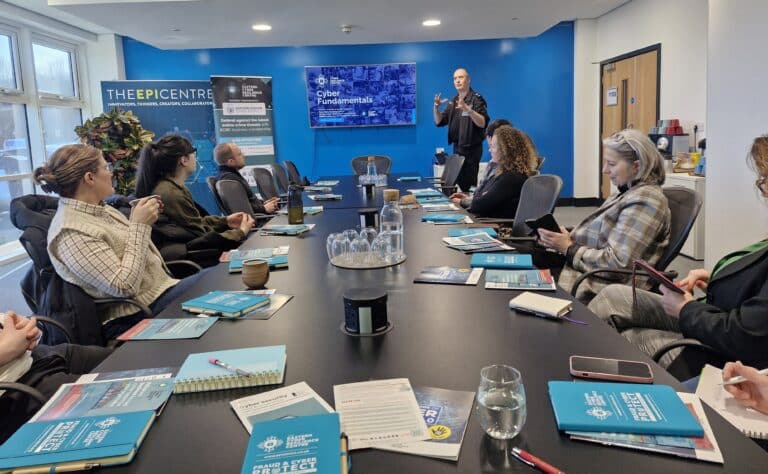
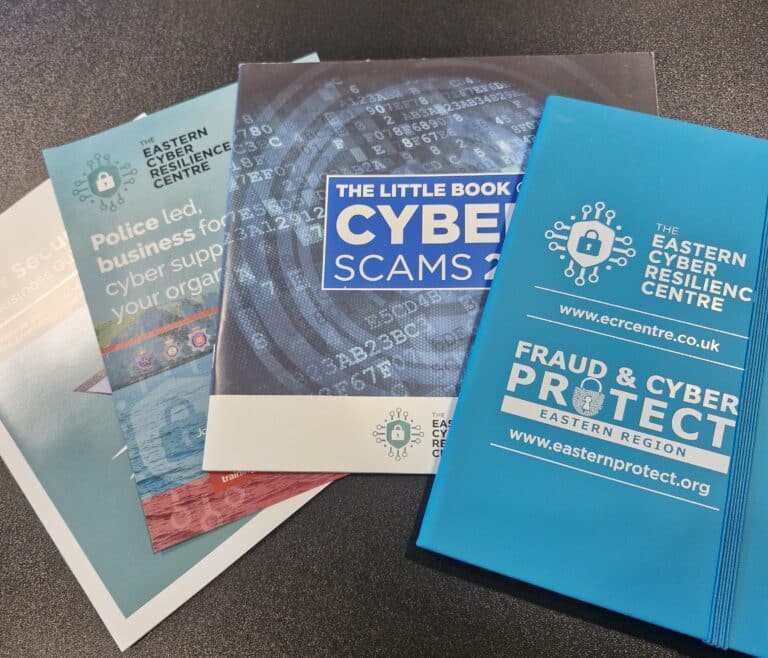
Want to learn more? Sign up to the free Eastern Cyber Resilience Centre session being held at The EpiCentre on 7th May 2026, 10am – 11am.
To find out more about Office Space | The EpiCentre | Haverhill, Cambridge (epicentrehaverhill.co.uk)
To find out more about Lab Space | The EpiCentre | Haverhill, Cambridge (epicentrehaverhill.co.uk)
To find out more about Our Members | The EpiCentre | Haverhill, Cambridge (epicentrehaverhill.co.uk)
To find out more about Business Support | EpiCentre | Cambridge, Haverhill (epicentrehaverhill.co.uk)