

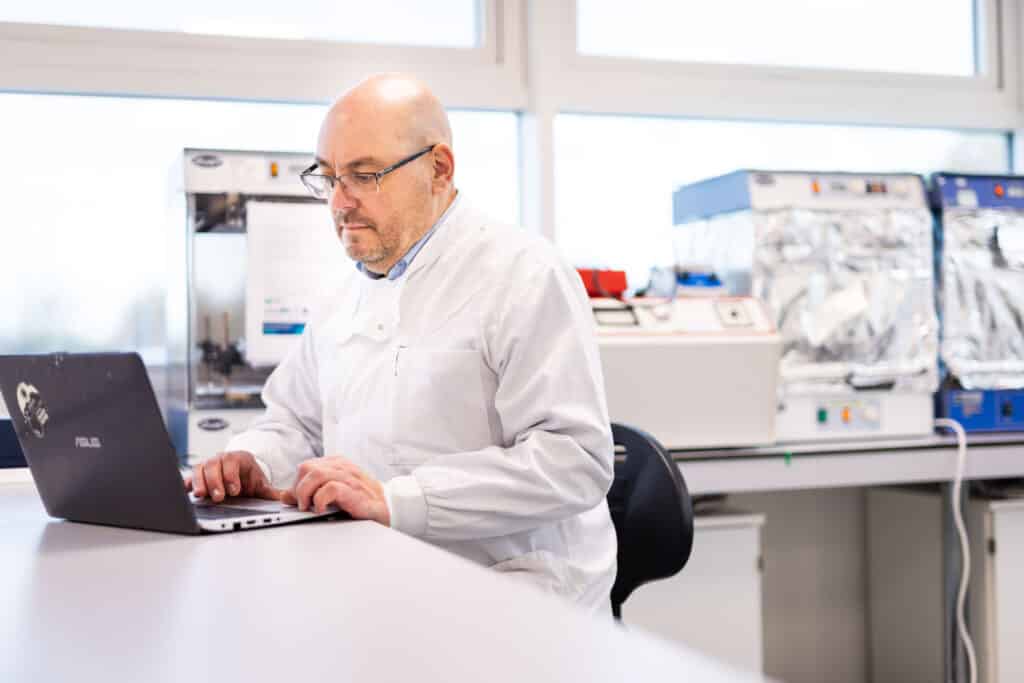
Finding the right laboratory is one of the biggest decisions when you’re growing a science business. You’re looking for a solution that will support your work safely, but will also suit your team, funding, operations, and plans for growth.
A standalone laboratory gives you maximum control, whilst a specialist research park offers access to a strong sector cluster. For early-stage and growing companies, our innovation centre is a valuable middle ground: specialist workspace with the added bonus of shared equipment, infrastructure, flexibility and business support.
What should you look for when choosing laboratory space?
Before comparing locations or costs, ask yourself: can this laboratory safely and practically support our work now, and whatever our future plans are?
Every business is different. Depending on your work, you may need to think about containment requirements, ventilation and extraction, power, water and drainage, gases, specialist equipment, cold storage, waste management, security and access. A deep-tech business needing dry lab space will have very different needs from a biotech company doing wet-lab research, and those needs can shift as the research develops.
That’s why it’s worth discussing technical requirements early. Within The EpiCentre, laboratory specialists are involved from the first enquiry to assess what you plan to do, while businesses remain responsible for their own scientific work, risk assessments and regulatory obligations.
Shared or dedicated lab space?
Shared laboratory space gives you access to specialist infrastructure, equipment and services in a managed environment, alongside other businesses. For a university spinout leaving academic facilities, it may be your first time running a business, but the support you receive in our shared space suits early-stage businesses, proof-of-concept projects, and small teams that don’t yet need a full private laboratory.
As you grow, a dedicated lab within a managed environment gives you more privacy and control while keeping access to centre services and support. A standalone laboratory makes more sense if you need a highly bespoke fit-out, specialist manufacturing, substantial dedicated equipment or complete control.
Rather than asking which model is best, try asking: what do we need to control ourselves, and what would we benefit from accessing through a managed environment?
Look beyond the headline cost of lab space
When comparing laboratory space to rent, the rent cost only tells part of the story. A standalone unit can mean extra investment in fit-out, utilities, equipment, storage, security, cleaning and waste arrangements before research can begin, and designing and commissioning the space takes time, often while founders are recruiting, raising investment or chasing research milestones.
Our managed lab space already provides the expertise and some of the infrastructure, leaving an early-stage business more capacity to focus on people, research, and commercial development.
A better question is: what will it cost, how long will it take and what will our team have to manage before we can start our work?
Choose flexible lab space that can grow with your business
Science businesses rarely grow in a straight line. A small startup might recruit quickly after investment, or a proof-of-concept project may soon need a dedicated lab, more equipment or office space. Flexible lab space lets you match your commitment to where you are now, from shared benches to a dedicated laboratory, adding office and workshop space as you grow.
But don’t just assume flexibility; test it. Ask what happens if you need another bench, new equipment or more private space, or if you eventually outgrow the centre.
Your laboratory doesn’t need to support your business forever. It needs to support where your business is going next.
Why choose lab space in an innovation centre?
Scientific work might happen at the bench, but growing a science company also means funding, recruitment, partnerships and commercial strategy. An innovation centre brings these together, with offices and meeting rooms, business support, events and connections to advisers, suppliers, researchers and other founders.
That wider environment can be especially valuable for first-time founders. But community alone isn’t enough: ask who is in the ecosystem, how businesses are connected and whether those relationships will matter to your future. The best environment supports the business growing around the science, rather than treating the laboratory as an isolated workspace.

Questions to ask when choosing laboratory space
Before committing to a lab, ask:
- What equipment and infrastructure are included?
- What will we need to provide or manage ourselves?
- What is included in the cost and what is charged separately?
- What are our own safety and regulatory responsibilities?
- Can we add lab, office or workshop space as we grow?
- What business support, networks and relevant connections are available?
Looking for lab space for your next stage?
Whether you’re moving out of university facilities, taking on your first commercial lab or expanding a growing team is a big step. The right space shouldn’t just suit the science you’re doing today; it should support the business you’re building for tomorrow.
Talk to our team about your scientific requirements, equipment and growth plans, and we’ll help you find the environment that fits your next stage, from shared lab space to dedicated laboratories.
Explore our laboratory spaces
To find out more about Office Space | The EpiCentre | Haverhill, Cambridge (epicentrehaverhill.co.uk)
To find out more about Lab Space | The EpiCentre | Haverhill, Cambridge (epicentrehaverhill.co.uk)
To find out more about Our Members | The EpiCentre | Haverhill, Cambridge (epicentrehaverhill.co.uk)
To find out more about Business Support | EpiCentre | Cambridge, Haverhill (epicentrehaverhill.co.uk)